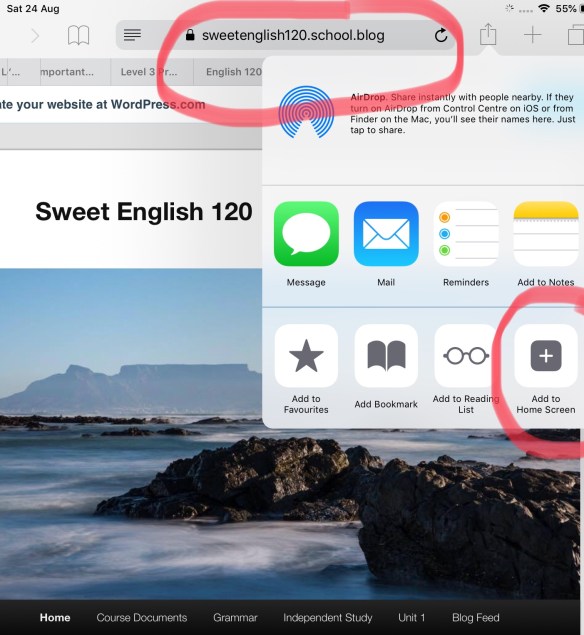
Get organised in three easy steps! If you save this site to your home screen, you will be able to find it quickly in class time.
Open our wordpress site ( sweetenglish120.school.blog ) in Safari. Tap on the icon to the right or left of the address bar. Choose ‘Add to home screen‘.
2. Follow our blog: Just click on the ‘Follow’ button at the bottom right hand side of the page and enter your university address when the dialogue box pops up. When you follow the blog you will get an email alert every time something new is posted.
Use the dictionary to look up words you don’t know.
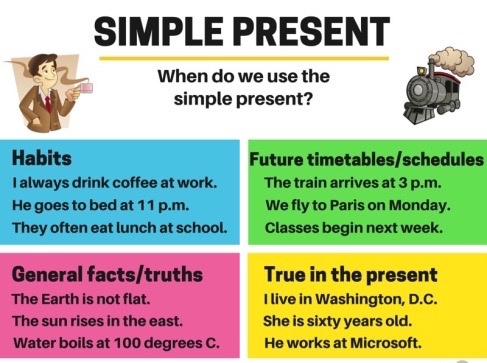
Find 11 examples of the verb ‘to be’ in the Simple Present Tense.
Find 12 examples of other verbs in the Simple Present Tense
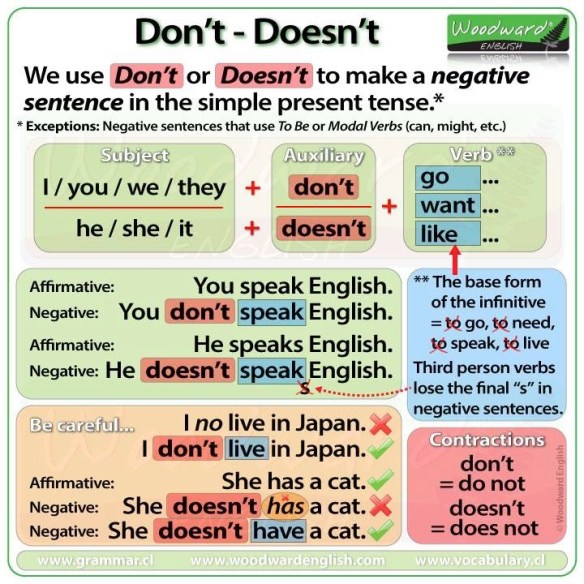
Find 1 example of a negative form of the Simple Present tense.
Now look for words that describe nouns – words that make the text more interesting.
What comparisons can you find in this text?
The Kestrel
The kestrel is a small, chestnut brown bird of prey. It belongs to the falcon family. Kestrels are 32–39 cm (13–15 in) from head to tail. Their wings are 65–82 cm (26–32 in) when spread out. Females are larger. Kestrels are smaller than other birds of prey. Like the other members of the falcon family, they have long wings and a long tail. Their feathers are mainly light brown with black spots on the top and narrow blackish streaks on the underside. The kestrel’s hooked bill is a bluish colour with bit of yellow at the top. The legs are yellow.
The kestrel is unusual because it is the only bird of prey that can hover. When hunting, the kestrel hovers about 10–20 m (c.30–70 ft) above the ground. Kestrels have very good eyesight. They can see small prey from a distance. Once they see the prey, the bird makes a short, steep dive. They eat only mouse-sized mammals, large insects and small birds.
Kestrels are bold, and have adapted well to humans. They nest in buildings and hunt by main roads. Kestrels do not build their own nests, but use nests built by other birds.
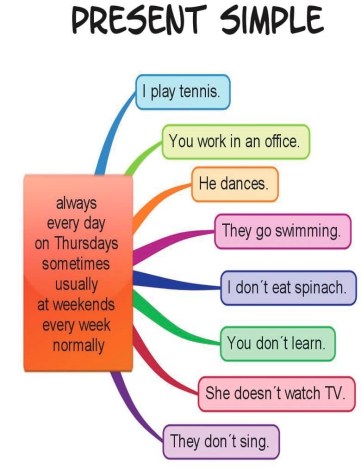
Look at the mind map below. It will help you to understand the difference between the Present Simple `and Present Continuous. Pay attention to the special SIGNAL WORDS used with these tenses.
You cannot form the Present Continuous unless you already know how to form the Present Simple of the verb ‘to be’. (is, am, are)
See here for an explanation of the form and function of the Present Progressive Tense
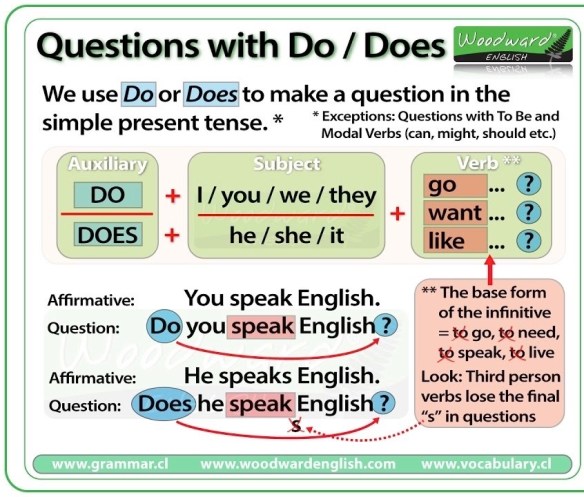
The Present Continuous: Questions and Statements and Question Forms
Statements: Positive and Negative statements
Note:
There are some verbs that cannot be used in the Present Continuous Tense. We call these ‘stative verbs’. These “stative” verbs are about state, not action, and they cannot express the continuous aspect. Here are some of the most common non-continuous verbs:






 See
See 


 Sweet English 120